

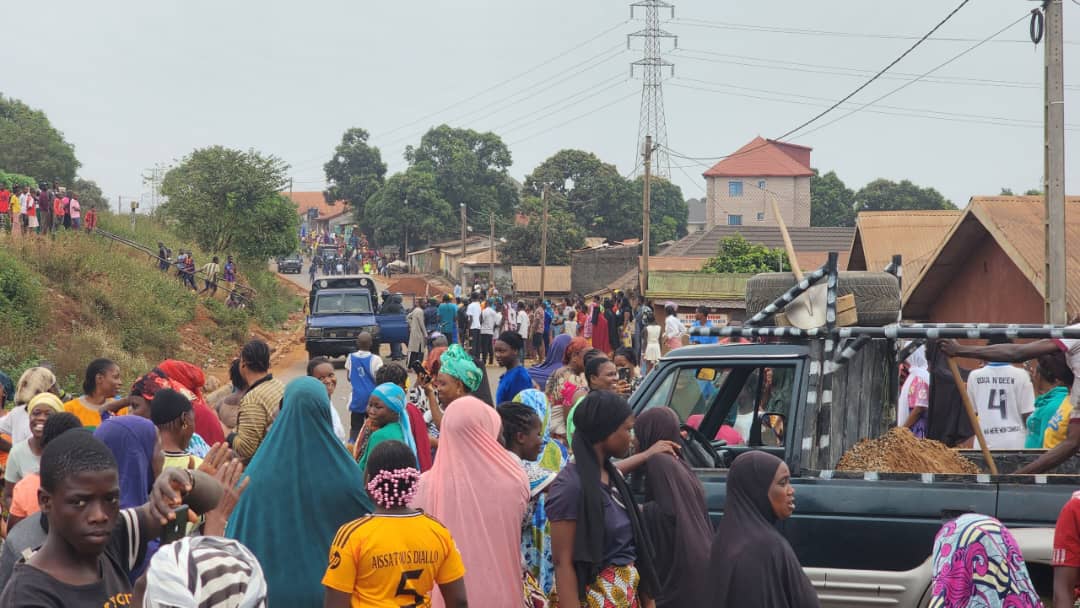
What began as a local protest in the Kalokhoya neighborhood of Manéah on Tuesday, December 16, reveals a critical, global tension in urban development: the clash between efficient traffic flow and the fundamental right to community safety. Women took to the new bypass road linking the Cement Plant to the T10, not just to voice a grievance, but to issue a stark ultimatum following a fatal accident. Their demand—the installation of speed bumps—is a simple, tangible solution that underscores a profound failure in infrastructure planning that prioritizes vehicles over human lives.
The protest was not an impulsive act but a calculated response to a systemic problem. Early that morning, the women of Kalokhoya, often the primary caregivers and managers of household logistics, erected barricades on a vital artery. This road serves as a crucial alternative to the deteriorated Leprince highway, absorbing heavy traffic, especially during rush hours. By blocking it, they weaponized their understanding of the road’s economic importance to force authorities to acknowledge its human cost. Their action followed a devastating incident on December 15, where a truck driver and his apprentice on a motorcycle were struck. As protester Aïssatou Diallo recounted, the outcome was tragically familiar: “One died and the other suffered fractures and is in a very critical condition. The driver who hit them fled.” This hit-and-run epitomized the culture of impunity and danger they sought to combat.
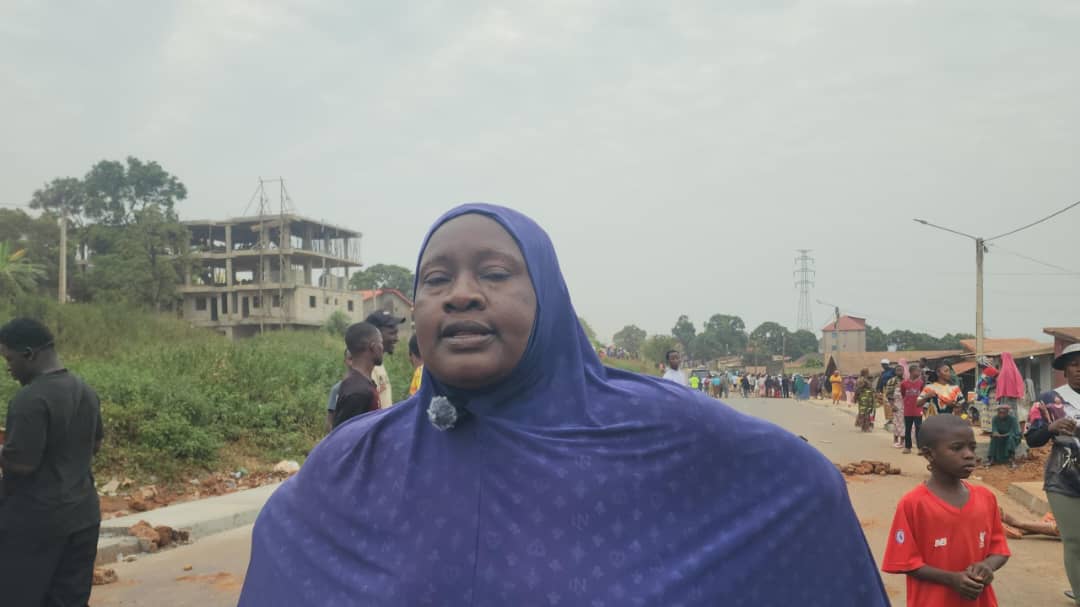
The core of their argument exposes a common flaw in new road projects: design focused solely on throughput, neglecting the lived reality of the adjacent community. “Drivers speed by at high speed, with no caution. Yet, women cross this road to go to the market and children to go to school,” Diallo explained. This transforms a corridor of convenience for commuters into a daily gauntlet for residents. The demand for speed bumps (or more formally, traffic calming measures) is a classic, grassroots intervention. Speed bumps physically enforce lower speeds, dramatically reducing both the likelihood and severity of accidents. Studies, such as those by the World Health Organization, consistently show that a pedestrian struck by a vehicle traveling at 50 km/h has an 80% risk of fatal injury, compared to less than 10% at 30 km/h. The women of Kalokhoya were, in effect, advocating for evidence-based public health policy.
This protest sits within a wider global context of community-led advocacy for safer streets. From “Vision Zero” initiatives in Sweden and the United States, which aim to eliminate all traffic fatalities, to grassroots movements in cities like Bogotá and Mumbai, the principle is the same: streets are public spaces that must be safe for all users, not just drivers. The deployment of security forces to clear the barricades and restore traffic flow is a standard, short-term response to civil disobedience. However, the true resolution lies in whether the Ministry of Public Works heeds the community’s technical solution.
Will the authorities see the speed bumps as a sensible concession to public safety, or as an impediment to traffic efficiency? The installation of these measures would represent a victory for participatory urbanism—a recognition that those who live with the consequences of infrastructure decisions must have a say in their design. If ignored, the underlying risks remain, promising further tragedy and likely more disruptive protests. The women of Kalokhoya have moved beyond mere complaint; they have presented a clear, actionable demand. The ball is now in the court of the planners and engineers to decide if safety is a right or an inconvenience.
Souleymane Bah
Analysis expanded with context on traffic calming, public health data, and global urban safety movements.