


In a decisive national response to one of its deadliest peacetime attacks, the Australian government has announced a major firearm buyback scheme, aiming to remove thousands of weapons from circulation. The announcement by Prime Minister Anthony Albanese comes as the country grapples with the aftermath of the Bondi Beach shooting, which claimed 15 lives during a Jewish festival.
Australia will launch its largest gun buyback in decades following one of the country’s deadliest mass shootings.
Prime Minister Anthony Albanese, framing the policy as a direct consequence of the tragedy, stated the government would implement a sweeping buyback to “get guns off our streets.” The scheme targets “surplus, newly banned, and illegal firearms,” offering financial compensation to owners who surrender them. This move signals a significant tightening of Australia’s already strict gun laws, which were famously reformed after the 1996 Port Arthur massacre.
The alleged perpetrators, 50-year-old Sajid Akram and his 24-year-old son Naveed, are accused of opening fire on the crowded beachfront. Authorities believe the pair drew inspiration from the Islamic State group. A critical focus of the investigation and the political response has been how Sajid Akram legally owned six high-powered rifles. “There is no reason someone living in the suburbs of Sydney needed this many guns,” Albanese asserted, vowing to close legislative loopholes.
Context: Australia’s Legacy of Gun Control
This buyback will be the largest since the landmark 1996 National Firearms Agreement (NFA). Following the Port Arthur shooting, that bipartisan reform banned rapid-fire long guns, established a national firearm registry, and mandated a permanent buyback that saw over 650,000 weapons destroyed. The policy is widely credited with a dramatic and sustained decline in gun-related homicides and mass shootings, serving as a global model. The new announcement seeks to reinforce that legacy by addressing weapon stockpiling and newer threats.
ALSO READ: Australia moves to tighten gun laws after deadly Bondi Beach attack
The nation will officially honour the victims with a national day of reflection this Sunday. Albanese has urged Australians to light candles at 6:47 pm—the precise time the attack began one week prior—creating a nationwide moment of solidarity and remembrance.
High alert
Security remains heightened across Sydney. In a tense development, armed police detained seven men on Thursday based on intelligence suggesting a potential plot for a “violent act” at Bondi. While all were released without charge on Friday, with police stating there was “no established link” to the Akrams and “no immediate safety risk,” the incident underscores the ongoing state of alert.
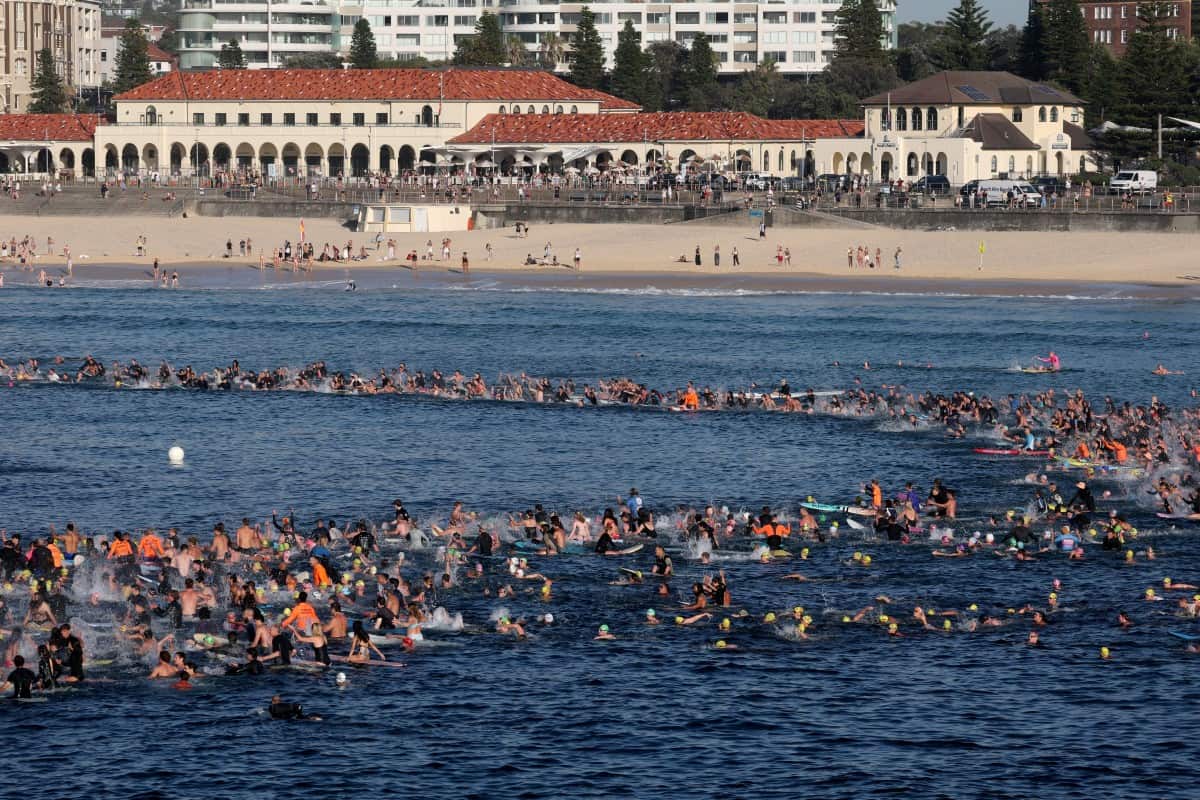
Amid the grief and tension, powerful acts of communal healing have emerged. On Friday, hundreds of swimmers and surfers returned to the waters off Bondi Beach, forming a solemn circle in the ocean to honour the dead. The gathering was a visceral display of resilience, with participants splashing water and sharing emotional embraces in the gentle swell.
“They slaughtered innocent victims, and today I’m swimming out there and being part of my community again to bring back the light,” said security consultant Jason Carr, 53. Carole Schlessinger, 58, described a “beautiful energy” at the gathering, noting, “To be together is such an important way of trying to deal with what’s going on… I personally am feeling very numb. I’m feeling super angry. I’m feeling furious.”
ALSO READ: South Africa condemns Sydney terrorist attack that killed 12
Heroes
Meanwhile, the first funerals for victims have begun. Boris and Sofia Gurman, a married couple and Bondi locals, were laid to rest in a Jewish ceremony. They were among the first killed as they heroically attempted to wrestle the gunman to the ground. “The final moments of their lives they faced with courage, selflessness and love,” Rabbi Yehoram Ulman told mourners. “They were, in every sense of the word, heroes.”
Father Sajid was killed in an ensuing gunfight with police. His son, Naveed, an unemployed bricklayer, survived and now faces 15 counts of murder, terrorism charges, and dozens of other serious offences. The investigation continues to explore the pair’s radicalization, including a possible meeting with Islamist extremists during a recent trip to the Philippines.
ALSO READ: Reddit files legal challenge to Australia social media ban
The Bondi attack has thus triggered a multifaceted national response: a swift policy initiative to strengthen gun control, profound communal mourning, heightened security measures, and a painful judicial process ahead. The coming weeks will test the resilience of Australia’s social fabric and its decades-long consensus on firearm regulation.