

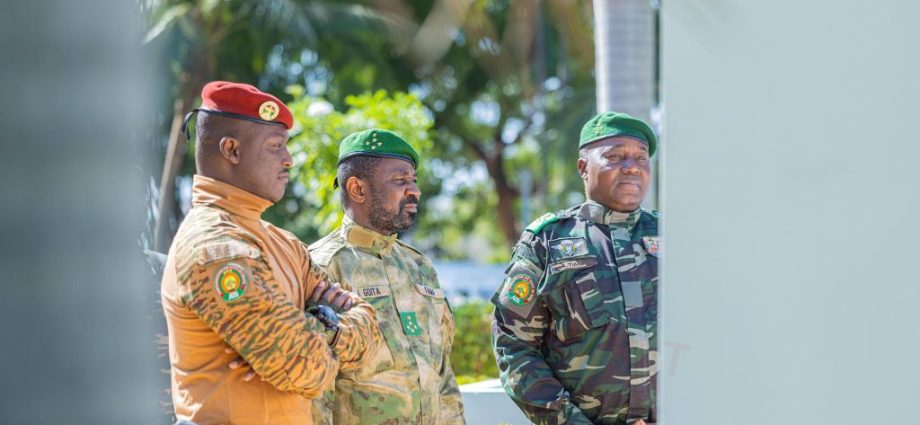
Following the 2nd Session of the College of Heads of State of the Confederation of Sahel States (AES), held on December 23 in Bamako, the leaders of Burkina Faso and Niger expressed their profound gratitude to the Malian authorities for the successful organization of this high-level meeting.
The closing of the 2nd Session of the Alliance of Sahel States (AES) College of Heads of State in Bamako was marked by more than just formal declarations. In a powerful joint motion, Captain Ibrahim Traoré of Burkina Faso and General Abdourahamane Tiani of Niger extended effusive praise for the “quality of the welcome and organization” provided by their host, Malian President General Assimi Goïta. This public commendation, while diplomatic in nature, serves as a critical signal of deepening fraternity and operational trust within a bloc that is rapidly evolving from a political concept into a tangible geopolitical force.
The leaders specifically thanked President Goïta for “the generous hospitality and all the attentions” shown to their delegations. In the high-stakes context of the Sahel, where external partnerships are often scrutinized, such warmth is strategically significant. It underscores a conscious effort to build internal cohesion and a shared culture of mutual respect, directly countering narratives of fragmentation often projected onto the region.
This exchange of gratitude is not merely ceremonial. It actively reinforces the foundational ethos of the AES: “One Space – One People – One Destiny.” This triptych moves beyond sloganism when viewed through the lens of shared, existential challenges. The summit convened against a backdrop of persistent security challenges from jihadist insurgencies and growing diplomatic tensions with former international partners, notably the withdrawal of French forces and strained relations with ECOWAS. In this climate, the “warm welcome” symbolizes a safe political harbor—a space where the leaders can coordinate strategies away from external pressure.
The core discussions at the summit, as indicated, focused on pillars vital to the alliance’s survival and legitimacy:
- Sovereignty: This extends beyond political rhetoric. For the AES, it encompasses military sovereignty (through joint security initiatives and indigenous command structures), economic sovereignty (control over natural resources like gold, uranium, and cotton), and diplomatic sovereignty (the right to choose partners, potentially including Russia, Turkey, or Iran, on their own terms).
- Fight Against Terrorism: This is the most urgent operational bind. The summit likely addressed practical coordination beyond national borders, such as intelligence sharing, harmonized rules of engagement, and potentially the framework for a joint military task force to target sanctuaries in border regions that have long plagued individual national armies.
- Valorization of Natural Resources: This is the long-term economic vision. The bloc aims to transition from being raw material exporters to capturing more value domestically. This could involve joint negotiations with mining conglomerates, shared infrastructure projects for processing minerals, and creating a more integrated regional market to bolster economic resilience against sanctions or market shocks.
The successful hosting of this summit in Bamako, and the pronounced solidarity it showcased, positions Mali as a central node in the AES architecture. It demonstrates administrative capability and provides a model for future rotations. The event solidifies the AES as a pact of mutual political survival and a collective platform for navigating a complex international order. The warm welcome, therefore, was the first public-facing layer of a much deeper, strategic integration aimed at reshaping the destiny of the Sahel from within.
Source: L’Aube/La Rédaction