

Rally now takes in its traditional Saturday rest day before returning to action on Sunday.
As the dust settled on the 326-kilometer sixth stage into Riyadh, Toyota Gazoo Racing South Africa (TGRSA) could breathe a collective, albeit weary, sigh of relief. The first, notoriously punishing week of the 2026 Dakar Rally is complete, and all three of its GR Hilux IMT Evos have not only survived but are strategically positioned within the top 20—a testament to a philosophy of calculated progress over reckless aggression in the world’s toughest motorsport event.
Resting on a high
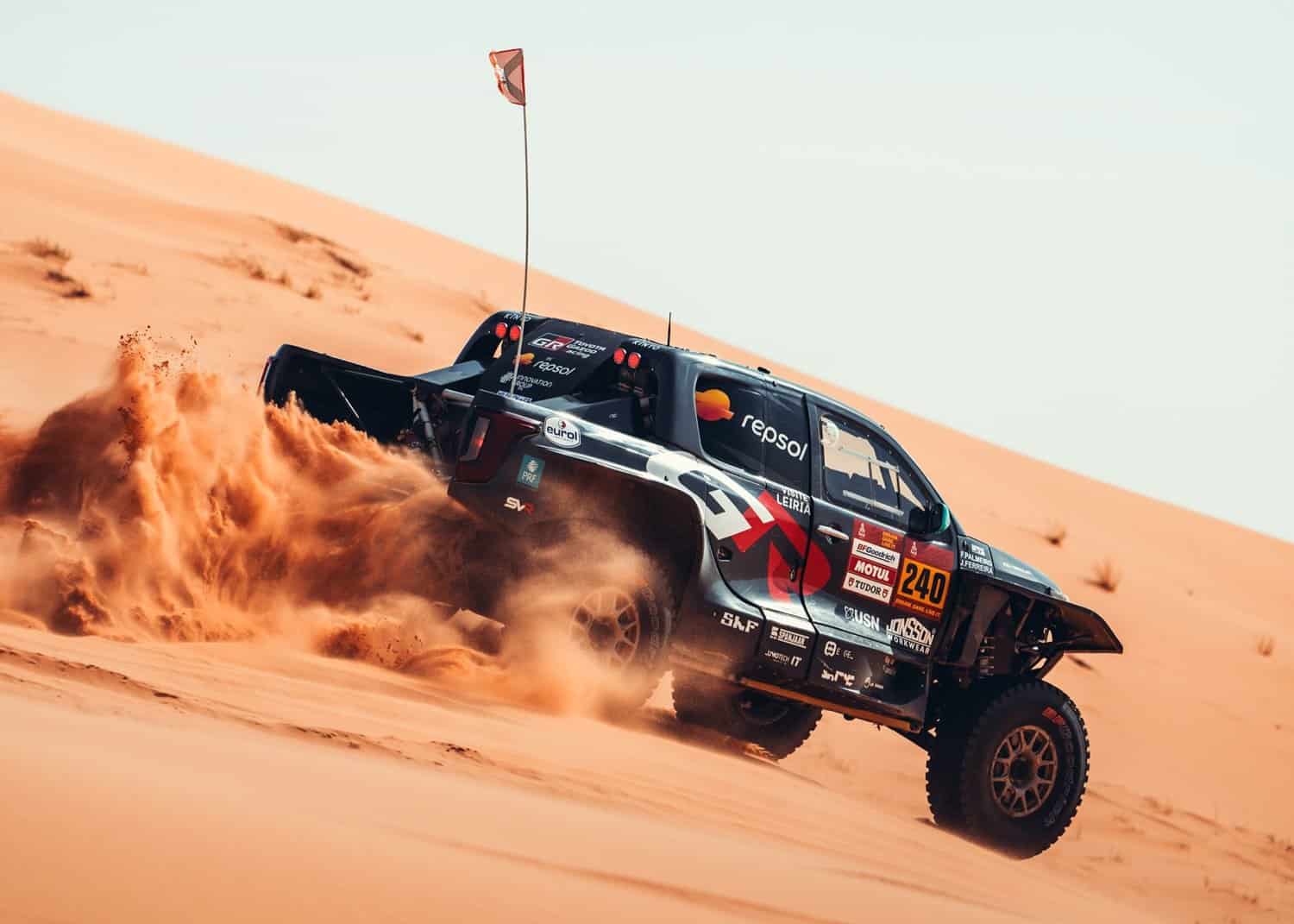
Leading the TGRSA charge is the #240 Hilux of Portuguese duo João Ferreira and Filipe Palmeiro. Their fifth-place finish on Stage 6, a stage they described as “much more dunes than we were expecting,” propelled them to 12th overall. This consistent, upward trajectory—starting 14th and gaining two places—exemplifies the Dakar adage: you can’t win the rally in the first week, but you can certainly lose it. Ferreira’s post-stage comment, “the car performed very, very well,” underscores the critical reliability of the Hilux platform in an environment where mechanical failure is the norm, not the exception.
In a fascinating twist of Dakar drama, the reigning South African Rally-Raid champions, Saood Variawa and Francois Cazalet (#213), actually gained a position in the overall standings despite a fraught stage. Finishing 14th on the day but moving up to 11th overall, their climb was hampered by late-stage fuel management issues. Variawa’s revelation that they had to nurse the Hilux for the final 40km highlights the razor-thin margins teams operate on. Their ability to conserve fuel, manage pace, and still advance positions makes them the top-placed TGRSA entry and a masterclass in damage limitation.
ALSO READ: Toyota Gazoo Racing South Africa ends Dakar marathon stages intact
The comeback story of the week belongs to Guy Botterill and Oriol Mena (#218). After a disastrous Stage 5 left them languishing, the duo mounted a fierce recovery on Stage 6. Starting 20th, they charged to a ninth-place stage finish, rocketing up to 17th overall. Botterill’s focus on the positive—”really happy with our performance… it was really cool to get some nice dunes under our belt”—signals a team that has mentally reset and is building momentum at the perfect time, just before the rest day.
New leader
The overall battle at the front showcases a fascinating narrative. Nasser Al-Attiyah, the Dakar legend, leads in his Dacia Sandriders, but hot on his heels is the Toyota of Henk Lategan and Brett Cummings. After two consecutive stage wins, a single tougher stage (12th place) saw them swap the lead, now sitting just 6 minutes and 10 seconds behind. This sets up a classic Dakar duel for Week 2: the experienced, tactical Al-Attiyah versus the charging, stage-winning pace of the Toyota crew. Notably, the top ten is a melting pot of machinery, with Dacia, Toyota, Ford, and even a Century CR7 proving the diversity and competitiveness of the modern T1+ class.
- Nasser Al-Attiyah/Fabian Larquin
– Dacia Sandriders
– 24h 18′ 29′ - Henk Lategan/Brett Cummings
– Toyota Hilux
– 24h 24′ 39” - Nani Roma/Alex Haro
– Ford Raptor
– 24h 43′ 43” - Carlos Sainz/Lucas Cruz
– Ford Raptor
– 24h 30′ 18” - Mattias Ekstrom/Emil Bergkvist
– Ford Raptor
– 24h 30′ 40′ - Sébastien Loeb/Edouard Boulanger
– Dacia Sandriders
– 24h 36′ 05” - Mitch Guthrie/Kellon Walch
– Ford Raptor
– 24h 40′ 18” - Mathieu Serradori/Loïc Minaudier
– Century CR7
– 24h 41′ 58” - Eryk Gozal/Szymon Gospodarczyk
– Toyota Hilux
– 24h 43′ 29” - Lucas Moreas/Dennis Zenz
– Dacia Sandriders
– 24h 45′ 15”
Overall standings
The traditional Saturday rest day is far from a holiday. It is a 24-hour pit stop of intense activity: deep mechanical inspections, strategic planning for the second week’s varied terrain, and crucial physical and mental recovery for the crews. The race resumes on Sunday with a mammoth 462 km loop from Riyadh to Wadi Ad Dawasir, where navigation and endurance will be as critical as raw speed.
Rest time
For Toyota Gazoo Racing South Africa, Week 1 was a successful exercise in resilience. All three cars are intact, positioned in the hunt, and have each faced and overcome distinct challenges. As the rally enters its second half, the strategy will subtly shift from preservation to calculated attack. With the #213 Hilux as the spearhead and the #218 crew on a charge, TGRSA is perfectly poised to exploit the attrition that will inevitably strike the front-runners in the days to come.
ALSO READ: Toyota Gazoo Racing South Africa hit with more flats on Dakar stage 4