

As Mozambique enters the second day of 2026, the National Institute of Meteorology (INAM) has issued a detailed forecast highlighting a stark north-south weather divide. This pattern is not merely a daily fluctuation but a reflection of the country’s complex climatology, influenced by the Inter-Tropical Convergence Zone (ITCZ), the Mozambique Channel, and regional topography. Understanding these forecasts requires moving beyond the basic predictions to grasp their underlying causes and real-world consequences for agriculture, transportation, and public safety.
Northern & Central Regions: Persistent Rain and Thunderstorms
The provinces of Niassa, Cabo Delgado, and Nampula are forecast for a generally very cloudy sky with light to moderate, locally heavy rains and thunderstorms. This is typical for early January, as the ITCZ—a belt of low pressure and converging winds—often sits over northern Mozambique, driving convective activity. The northwest to northeast light to moderate winds are channeled by the Rift Valley and coastal influences. For residents and farmers, this signals continued high soil moisture. While beneficial for crops, it increases the risk of localized flooding, especially in low-lying areas of Cabo Delgado, and can disrupt overland travel on unpaved roads. The accompanying thunderstorms pose a risk of lightning strikes and sudden, gusty winds.
Central Interior & Zambézia Valley: Isolated Showers Amidst Heat
In Tete, Zambézia, Manica, and Sofala, the forecast calls for a partly to very cloudy sky with light to moderate rains and thunderstorms. This region often acts as a transition zone. The interior areas, particularly Tete, may experience significant heat buildup during partly cloudy periods, with the rains providing critical but sporadic relief. The northwest to east winds indicate a flow from the continental interior. For the agricultural heartlands of Zambézia and Sofala, these scattered rains are crucial for crops like sugarcane and maize, but farmers must carefully time irrigation and pesticide application around the showers. The heat in Tete underscores the importance of hydration and heat-stroke prevention for outdoor workers.
Southern Region: A Focus on Maputo and Gaza
The southern provinces present a nuanced picture. Maputo province and city, along with southern Gaza, are expected to have a generally very cloudy sky with moderate rains and thunderstorms. This is often driven by moisture influx from the Mozambique Channel and occasional frontal systems from the south. In contrast, the rest of Inhambane and Gaza may see partly cloudy conditions with lighter, localized showers. The northwest to southeast winds suggest a land-sea interaction. For urban Maputo, moderate rains can quickly lead to flash flooding in areas with poor drainage, causing major traffic disruptions. The forecast highlights the localized nature of weather events—conditions can vary significantly between Maputo city and the Limpopo River basin in Gaza.
Temperature and Climate Context: Beyond the Numbers
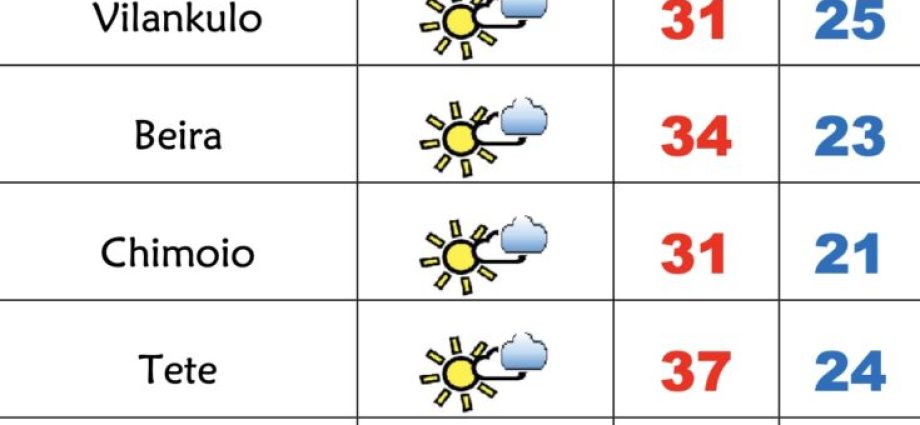
The forecasted temperatures, shown below, must be interpreted with humidity in mind. A high temperature in humid Nampula feels vastly different than the same temperature in drier Tete. This early January weather fits into broader seasonal patterns. Northern and central rains are consistent with the peak of the rainy season, while southern showers are more variable. Looking ahead, such data forms the baseline for monitoring seasonal trends and potential extreme events linked to broader climate phenomena like the Indian Ocean Dipole.
Practical Recommendations and Safety Advice
Based on this INAM forecast, citizens and authorities should consider several actions:
• Northern Provinces: Be alert for sudden downpours that may flood roads. Secure loose outdoor items ahead of predicted gusty winds.
• Central Region: Use breaks in rainfall for essential travel or fieldwork, but remain prepared for rapidly developing thunderstorms. Manage heat exposure diligently.
• Southern Region (especially Maputo): Commuters should plan for potential delays and avoid known flood-prone routes. Ensure drainage paths around homes are clear.
• Nationwide: Always heed official warnings related to thunderstorms, including seeking indoor shelter to avoid lightning risk.
INAM’s detailed regional forecast provides a critical tool for daily planning and long-term resilience. By understanding the meteorological drivers behind the predictions—from the ITCZ’s influence in the north to channel-driven moisture in the south—Mozambicans can better interpret these daily bulletins, making informed decisions to protect life, property, and livelihoods as the new year unfolds.