

Niger’s Leadership Bets on Youth-Led ‘Rebuilding’ Amid Economic Sovereignty Push
An analysis of the government’s domestic tour reveals a strategic pivot to mobilize the nation’s largest demographic as the engine for development and political consolidation.
NIAMEY – In a series of public meetings across the country, Niger’s post-coup authorities have articulated a clear doctrine: the nation’s future stability and economic sovereignty are inextricably linked to the fortunes of its youth. With over two-thirds of the population under 30, this is less a policy choice and more a demographic imperative. However, the recent domestic tour by President Abdourahamane Tiani has transformed this reality into a central pillar of the ruling National Council for the Safeguard of the Homeland’s (CNSP) political project, termed “the Rebuilding.”
This report is based on the primary source coverage from Le Sahel, the official newspaper of Niger.
From Rhetoric to Project Pipeline: The Employment Promise
Beyond the recurrent theme of youth inclusion, President Tiani’s speeches provided rare specifics on upcoming state-led projects poised to absorb young labor. The announcements function as both an economic plan and a social contract with a restless demographic.
The highlighted initiatives include:
- The Large-Scale Irrigation Program: Cited as already mobilizing youth in Diffa, with promises of significant expansion.
- Oil & Petrochemical Development: The state-owned SONIDEP’s exploitation of oil blocks in the Agadem to Bilma corridor, and the Dosso Petrochemical Complex, were explicitly framed as major future employers.
- Infrastructure & Hydraulics: Road and water infrastructure projects were pledged as additional job-creating sectors.
The President’s declaration that “it is no longer acceptable for people to come from elsewhere to work and profit at the expense of our population” directly ties youth employment to the government’s broader sovereignty and resource nationalism agenda.
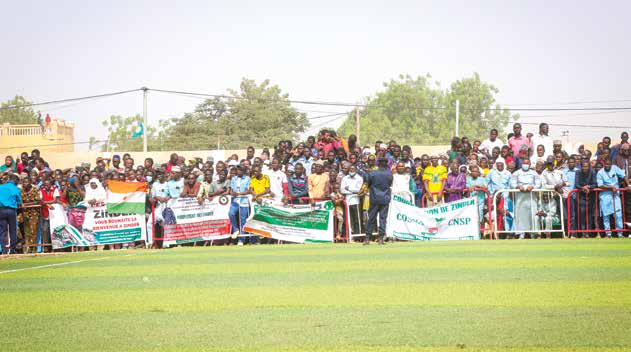
The Youth Response: Patronage, Patriotism, and Impatience
The source report provides curated reactions from youth representatives, offering a window into the government’s support base. The testimonials reveal a blend of patronage, genuine patriotism, and strategic pressure.
Figures like Nana Mariam Adji Gana expressed “profound satisfaction” with the access granted and commitments made, framing youth involvement as a hallmark of the CNSP era. Others, like Ardo Mamane Garba, linked youth support directly to the government’s “denunciation of agreements with imperialists,” suggesting the youth employment drive is politically synergistic with Niger’s recent foreign policy shifts.
However, not all feedback was purely celebratory. Hamidou Ganda Saley of a Agadez youth association urged authorities to “accelerate the implementation processes,” noting that “our country is in a state of urgency.” This underscores the high expectations and the pressure on the government to deliver tangible results swiftly.
Contextualizing the ‘Rebuilding’ Narrative
The relentless focus on youth during the tour cannot be divorced from Niger’s contemporary political context. Following the July 2023 coup and the subsequent rupture with traditional Western partners like the US and France, the CNSP government is engaged in a multifaceted battle for legitimacy—both domestically and internationally.
Domestically, channeling national resources toward the majority youth population is a potent tool for building popular legitimacy and social stability. By promising to create jobs so that “no Nigerien has to leave this country in search of work,” the government addresses a key grievance and source of insecurity. Externally, it projects an image of a forward-looking, self-reliant administration focused on internal development rather than external alignment.
Analysis: The Risks and Rewards of a Demographic Strategy
Placing youth at the “heart of the rebuilding” is a high-stakes strategy. The potential rewards are significant: harnessing the energy of a burgeoning population for national development, fostering stability, and securing a long-term base of support for the current political project.
However, the risks are equally substantial. The strategy raises public expectations to a zenith. The announced projects in oil, irrigation, and petrochemicals are capital-intensive, technically complex, and often subject to delays. If job creation fails to materialize at the promised scale or pace, the government’s core pledge to youth could backfire, transforming hope into frustration among its most critical constituency.
Furthermore, the approach leans heavily on state-led, extractive, and infrastructure-based employment. Long-term sustainability will depend on whether this model can foster a diversified private sector and entrepreneurial ecosystem for youth beyond direct government employment.
Conclusion: Niger’s leadership is attempting to convert a demographic reality into a political and economic engine. The domestic tour, as reported, served as a national rollout of this compact. The “rebuilding” narrative now carries a concrete, youth-centric promise. The government’s stability in the coming years may hinge less on diplomatic maneuvers and more on its ability to turn these project announcements into paychecks for the young population it has so centrally placed its faith in.