

Predicting the future of wine is a notoriously tricky endeavor, akin to forecasting the weather in a changing climate. Yet, by examining the powerful currents of climate science, consumer behavior, and technological innovation, we can chart a remarkably clear course for the year ahead. 2026 is poised to be a pivotal year of transformation, where adaptation and authenticity become the industry’s guiding principles.
The Unavoidable Catalyst: Climate Change Reshapes the Map
The most significant and irreversible force remains climate change. The UK Met Office’s prediction that 2026 will rank among the warmest years on record is not an abstract statistic; it’s a direct operational challenge for vignerons worldwide. The consequences—more frequent heatwaves, droughts, floods, and wildfires—are forcing a fundamental geographical rethink. While historic regions in France, Italy, and California grapple with vintage variation and water stress, a new viticultural frontier is emerging. Look for accelerated planting in previously marginal, cooler climates like Sweden, the UK, Tasmania, and Patagonia. This isn’t just about survival; it’s an opportunity for new terroirs to express themselves, potentially yielding the classic wine regions of tomorrow.
The Consumer Revolution: Demographics and Mindset
Contrary to narratives of decline, wine consumption is undergoing a generational handover, not a collapse. Data confirms that Millennials (born 1981-1996) are now the largest wine-drinking cohort, with Gen Z (1997-2012) rapidly increasing consumption as they come of age. This shift is profound. These consumers reject stuffy, elitist connotations. For them, wine is an integral part of pop culture, sports (e.g., NBA-label wines), and streaming entertainment (like Netflix’s Champagne Problems). The zeitgeist is “make wine fun again,” favoring exploration over prestige.
This demographic shift fuels three dominant trends:
1. The Non-Alcoholic Evolution: Driven by health-consciousness and improved dealcoholization technology, this category is moving from an afterthought to a mainstream offering. Major investments, like Castel’s €10 million facility in the Loire, signal serious, quality-focused production that aims to preserve varietal character.
2. The Sparkling Explosion: Bubbly is no longer reserved for celebrations. It’s a versatile, Instagram-friendly lifestyle drink for any occasion. While Champagne faces headwinds, the broader sparkling category thrives. Expect a proliferation of French Crémants, English Sparkling Wine, dry Lambrusco, and Sekts from Germany and Austria, offering compelling value and diversity. The real excitement lies in regional expressions like Sicily’s Mt. Etna Spumante (from native Grillo) or Corsican fizz from native grapes, championed by experts like former Dom Pérignon winemaker Richard Geoffroy.
3. The Value Hunt: Economic pressures make value-for-money paramount. The savvy drinker will look beyond famous appellations to regions like Greece’s Crete (for Liatiko reds), Portugal’s Douro (for Touriga Franca), Sicily (for Grillo whites), and Spain (for Godello). Even in California, grape gluts are inspiring new “négociant” labels that offer premium fruit without the famous-name price tag.
Beyond the Bottle: Experiences and Ethics
For younger consumers, the story behind the wine is as important as what’s in the glass. This manifests in two key ways:
Immersive Wine Tourism: The simple tasting room is evolving. Wineries are becoming hubs for adventure, with 73% planning to expand activities like mountain biking (e.g., Rhebokskloof Estate in Paarl), quad biking (Morgenhof Estate in Stellenbosch), or paragliding in Franschhoek. These experiences build deeper emotional connections with the brand and locale.
Regenerative Farming: Eco-ethics are moving beyond sustainability to regeneration—farming practices that actively improve ecosystem health. This investment addresses both climate resilience and a consumer demand for transparency and environmental stewardship.
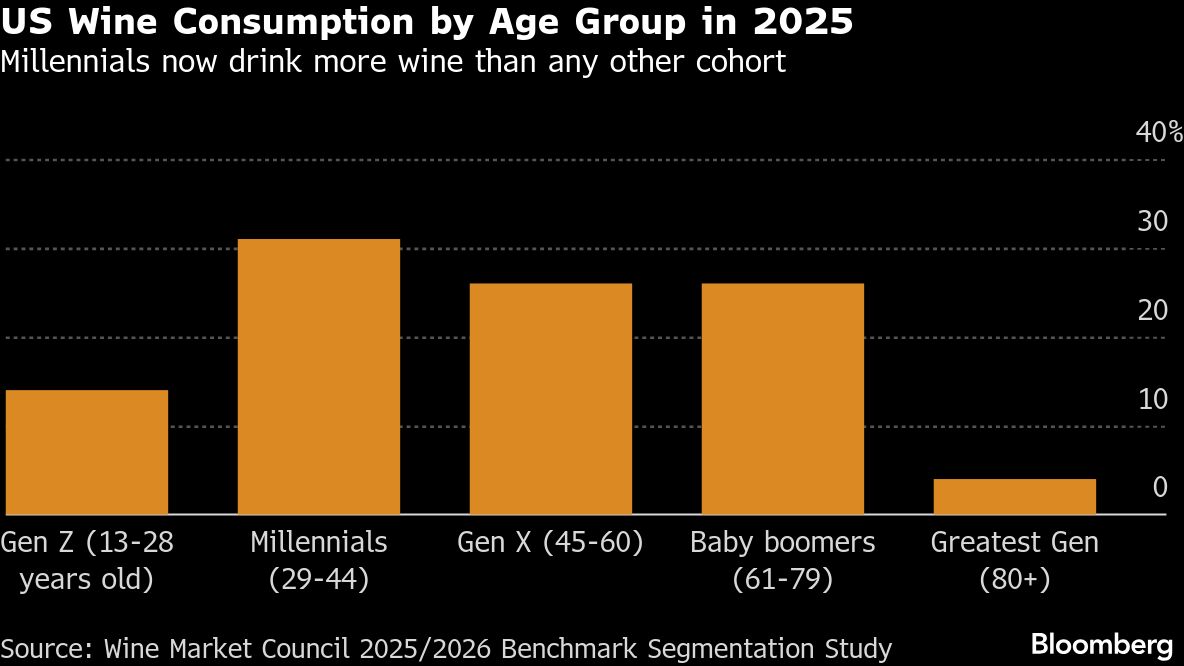
Source: Bloomberg – A visual representation of shifting consumption trends or climate impact data.
The Tech-Enabled Future: AI from Vine to Glass
Artificial Intelligence is permeating every layer of the industry. In the vineyard, AI-powered drones and sensors monitor vine health and optimize harvests. In the cellar, robots handle precise tasks. For consumers, AI is becoming a virtual sommelier and travel concierge. Partnerships, like the Napa Valley Marriott with Preferabli’s AI, promise hyper-personalized wine and itinerary recommendations. However, a note of caution: as reported, AI like ChatGPT may currently favor well-known spots. For true hidden gems, the human sommelier’s insight remains irreplaceable—for now.
Radical Simplification: The Death of the Formal Wine List?
In casual dining, the encyclopedic wine list is giving way to conversation. Establishments like Brooklyn’s Sauced or Paris’s Les Enfants du Marché operate on a dialogue-based model: you describe your preferences, and the somm brings tastes. This lowers intimidation and prioritizes personal matchmaking, though it may frustrate enthusiasts seeking a broad overview. Similarly, keg wine and curated mini-bottles (like Daou’s 100ml “test tubes”) offer flexibility and reduce waste.
“The future of wine isn’t about clinging to old benchmarks; it’s about embracing fluidity—in climate, in culture, and in how we choose to enjoy it.”
Open Questions for 2026
As we peer into the crystal ball, several intriguing questions remain:
• Will health warning labels on bottles gain traction, and how will the industry respond?
• Can Zinfandel stage a comeback, or will obscure varieties continue their rise?
• As Gen Z’s sweet tooth influences the market, will novel styles like chocolate-flavored reds find a niche?
• And perhaps most pressingly: How will the geopolitical landscape, including potential tariffs, impact the global flow and affordability of wine?
The world of wine in 2026 is not facing a single future, but a branching path of adaptation. It will be defined by a tension between tradition and innovation, between global challenges and hyper-local responses. One thing is certain: for the curious drinker, there has never been a more exciting—or consequential—time to explore.
© 2026 Bloomberg L.P.
Follow Moneyweb’s in-depth finance and business news on WhatsApp here.