

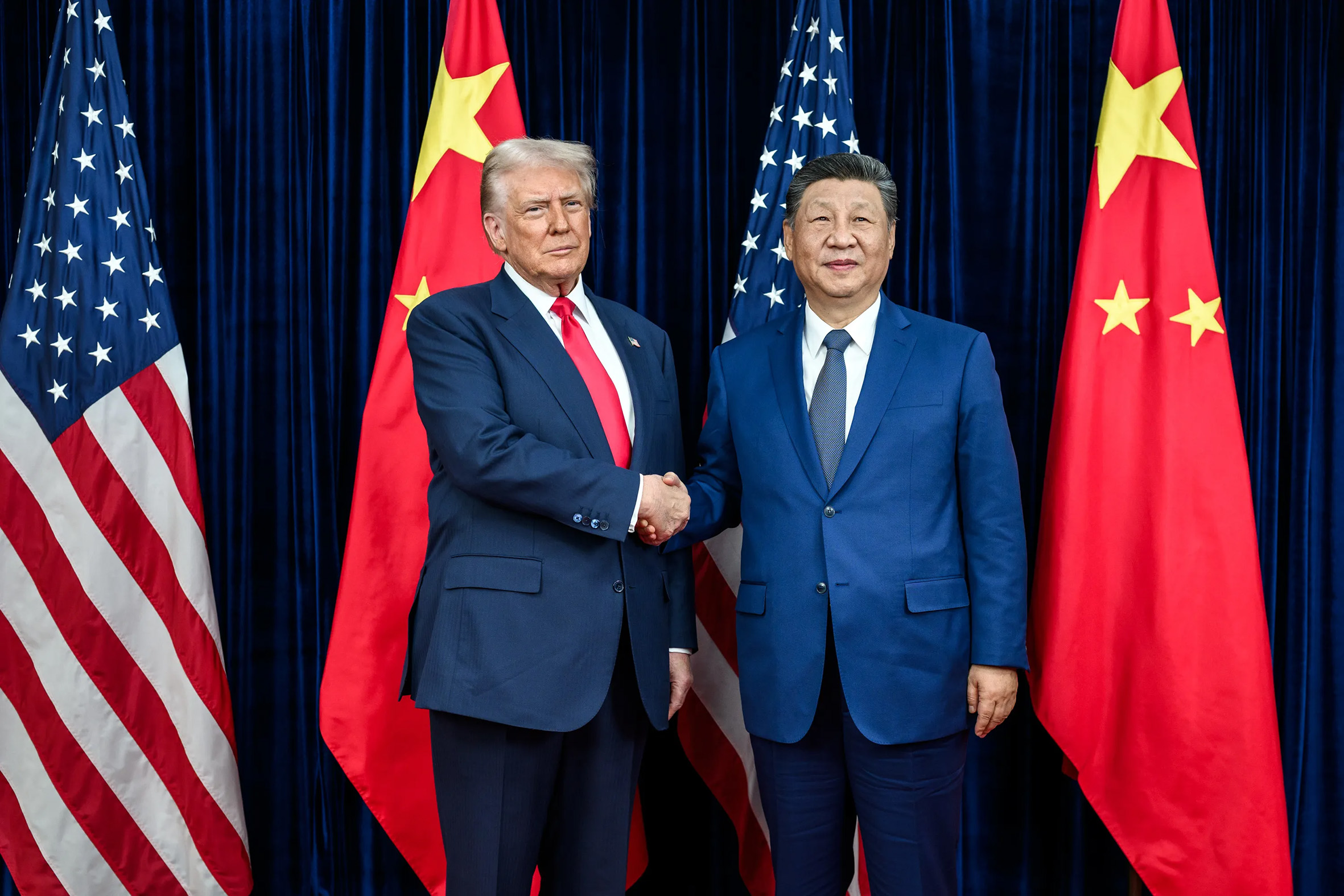
Tariff Tiff: President Donald Trump meets with Chinese President Xi Jinping. This moment, captured here, symbolizes the beginning of a strategic pivot whose economic aftershocks are now becoming fully apparent. Photo: The White House
The economic relationship between the United States and China has evolved from a trade dispute into a deliberate, high-stakes strategy of strategic decoupling. Driven by Washington’s imperative to safeguard national security and reduce supply chain dependencies, this policy shift is now revealing profound and often counterproductive consequences. A growing body of evidence suggests the decoupling strategy is inflicting significant structural damage on American industry, while China demonstrates remarkable resilience and strategic adaptation.
The political narrative, particularly under a renewed Trump administration, frames escalating tariffs and restrictions as a patriotic defense of American sovereignty and jobs. However, this rhetoric obscures a complex economic reality. The push for separation has acted as a stress test, exposing deep-seated vulnerabilities in U.S. industrial capacity and supply chains. Meanwhile, China has executed a rapid pivot, mitigating impacts and often emerging stronger in key sectors. This divergence between political objectives and economic outcomes is widening, creating a precarious new normal for global trade.
The Rare Earth Gambit: A Masterclass in Asymmetric Leverage
China’s October policy shift, requiring government approval for exports containing more than 0.1% rare earth content, was a strategic watershed. Rare earth elements—17 metals with unique magnetic and conductive properties—are not merely commodities; they are the lifeblood of modern defense systems (F-35 jets, missile guidance), the green energy transition (electric vehicle motors, wind turbines), and ubiquitous consumer electronics.
This was not a blunt-force embargo but a sophisticated demonstration of asymmetric leverage. By instituting a bureaucratic approval process, Beijing weaponized its near-monopoly (controlling over 80% of global refined output) without triggering the diplomatic backlash of an outright ban. The impact was immediate and multifaceted:
• Defense Sector: Contractors faced delays and cost overruns for critical components.
• Renewable Energy: Project timelines extended as costs for permanent magnets soared.
• Long-Term Vulnerability: While the U.S. has launched initiatives to revive domestic rare earth mining and processing (e.g., MP Materials in Mountain Pass), building a secure, fully integrated supply chain—from mine to magnet—is a decade-long endeavor. China’s move highlighted that America’s strategic industries remain on a medium-term leash controlled by Beijing.
How Tariffs Became a Self-Inflicted Wound
The renewed tariff regime, intended as a punitive tool to reshore manufacturing, has functioned primarily as a regressive tax on the American economy. The economic mechanism is clear: tariffs on intermediate goods (components and materials) increase production costs for U.S. manufacturers. These costs are then either absorbed, eroding profitability and investment capacity, or passed on to consumers, fueling inflation.
Practical Examples of the Backfire:
• Midwest Agriculture: Soybean farmers, once reliant on the Chinese market, faced retaliatory tariffs that slashed exports, leading to bankruptcies and federal bailouts. The “Phase One” deal failed to restore previous purchase volumes.
• U.S. Manufacturing: A furniture maker in North Carolina, using Chinese-sourced hardware and specialty fabrics, saw input costs jump 25%. Unable to instantly shift sourcing or raise prices competitively, it halted expansion plans.
• The Reshoring Mirage: The promise of large-scale manufacturing returning to the U.S. has largely failed to materialize. Instead, companies have pursued “China +1” strategies, often shifting low-margin assembly to Vietnam or Mexico while retaining dependence on Chinese subcomponents, thus adding complexity without reducing ultimate risk.
China’s Strategic Pivot: Diversification and Deepening
Contrary to expectations of economic capitulation, Beijing has used U.S. pressure as a catalyst for a profound strategic redirection. China is not merely surviving decoupling; it is actively constructing a parallel economic ecosystem.
Key Adaptation Strategies:
1. Trade Diversification: Through the Regional Comprehensive Economic Partnership (RCEP), China has deepened integration with Southeast Asia, effectively creating a tariff-free bloc that can internally circulate goods, many containing Chinese inputs. Exports to ASEAN nations have surged, offsetting declines to the U.S.
2. Belt and Road Initiative (BRI) 2.0: Investments in Africa and Latin America have become more targeted, securing critical mineral resources (like cobalt in the DRC and lithium in Argentina) and building infrastructure that locks in long-term trade relationships.
3. Vertical Integration: In sectors like electric vehicles (EVs) and solar panels, China has moved beyond being the “world’s factory” to dominating the entire value chain—from mining raw materials to manufacturing advanced batteries and final products. Companies like BYD and CATL now set global standards, making decoupling in these “future industries” exceptionally difficult.
The stark irony: as Washington pursues decoupling, Beijing is becoming more embedded as the indispensable nexus of alternative global supply chains.
The Fatal Flaw: The Geopolitics of Sourcing
Recent analytical research underscores a critical nuance often missed in policy debates: successful decoupling requires not just alternative suppliers, but politically reliable ones. A factory in a country that might align with China under pressure does not de-risk a supply chain.
This explains the patchwork, uneven nature of current decoupling:
• Successful Shifts: In semiconductors and advanced electronics, U.S. firms have leveraged strong alliances (e.g., with Taiwan, Japan, South Korea) to diversify away from China, supported by policies like the CHIPS Act.
• Persistent Dependence: In pharmaceuticals (active ingredients), consumer electronics (like Apple’s iPhone assembly), and legacy industrial materials, alternatives are either non-existent, prohibitively expensive, or located in geopolitically neutral countries like Vietnam or India, which maintain strong ties with China. This leaves vast swathes of U.S. industry in a state of vulnerable dependence.
The Mounting Costs: Competitiveness, Inflation, and Global Instability
The domestic and global repercussions are compounding:
• Eroded U.S. Competitiveness: American manufacturers are saddled with higher input costs than global rivals, making exports less competitive. The “protection” ironically weakens the protected.
• Global Inflationary Spillover: Disrupted trade flows and increased logistics costs have contributed to worldwide inflation, hitting developing economies hardest.
• The Ally’s Dilemma: Nations like Germany and South Korea face an impossible choice: align with Washington’s security agenda or protect vital economic ties with Beijing, their largest trading partner. This pressure is fracturing the unity of the U.S.-led alliance system.
• Systemic Fragmentation: The unraveling of the deeply integrated U.S.-China economic relationship threatens to bifurcate the global system into competing technological and trade blocs—a “splinternet” of standards, currencies, and supply chains that reduces efficiency, innovation, and growth for all.
Conclusion: Toward a Nuanced Realism
The evidence indicates a strategy failing its own objectives. Protectionism has not revived broad-based U.S. manufacturing but has instead raised costs and exposed vulnerabilities. China has proven to be a adaptable and strategic adversary, using the pressure to reduce its own dependencies and strengthen its global hand.
The path forward requires abandoning the binary rhetoric of total decoupling versus unfettered integration. A viable strategy must be selective and sector-specific:
• Aggressively decouple in truly critical, dual-use technologies (advanced semiconductors, AI hardware) with massive public investment and ally collaboration.
• De-risk and diversify in essential goods (pharmaceuticals, critical minerals) by building resilient, multi-country supply chains with trusted partners.
• Maintain engagement in non-strategic consumer goods where interdependence is mutually beneficial and provides leverage.
The current course—prioritizing political symbolism over economic pragmatism—imposes a clear cost. It is a cost paid not by Beijing, but by American consumers facing higher prices, by U.S. industries losing their competitive edge, and by a global economy pushed toward destabilizing fragmentation. The lesson is clear: in an interconnected world, indiscriminate decoupling is less an act of strength and more an exercise in self-sabotage.
Dr. Imran Khalid is a freelance columnist on international affairs based in Karachi, Pakistan. He qualified as a physician from Dow Medical University in 1991 and holds a master’s degree in international relations from Karachi University.